Himalayan Highway Engineering
Nowhere on Earth does road building confront such active tectonic upheaval as in the Himalayas. The collision between the Indian and Eurasian plates creates an environment where mountains continue to rise, rivers chisel slot canyons, and seismic activity regularly triggers catastrophic slope collapses.
1. Umling La (5,798 m / 19,024 ft) – The World's Highest Motor Road
Constructed by the Border Roads Organisation (BRO) under Project HIMANK and opened to military and civilian traffic in eastern Ladakh, Umling La eclipsed Khardung La to claim the official world record for motorable elevation. The road connects Chisumle and Demchok across permafrost terrain where winter temperatures plummet below -40°C.
Constructing blacktop asphalt at nearly 5,800 meters required proprietary bitumen chemistry. At this altitude, oxygen partial pressure is only 48% of sea-level values, meaning standard diesel heating burners in asphalt batch plants refuse to stay lit without supplemental oxygen injection. Specialized heavy excavators were fitted with dual turbochargers to clear rocky shelves without stalling.
2. The Leh-Manali Highway (475 km) & Rohtang Pass
The Leh-Manali corridor crosses four major passes: Rohtang La (3,978 m), Baralacha La (4,890 m), Nakee La (4,739 m), Lachulung La (5,059 m), and Taglang La (5,328 m). The route was historically one of the most dangerous in Asia, where meltwater rivers flooded road surfaces every afternoon as sun struck upstream glaciers.
The completion of the 9.02-kilometer Atal Tunnel beneath Rohtang Pass in 2020 transformed accessibility, bypassing the grueling 50-kilometer switchback climb over Rohtang and eliminating the risk of being stranded by early autumn blizzards. However, beyond the tunnel, travelers still face the Gata Loops—a sequence of 21 switchbacks that rise from 4,190 meters to 4,660 meters in just 7 kilometers.
3. The Karakoram Highway (N-35) – Khunjerab Pass
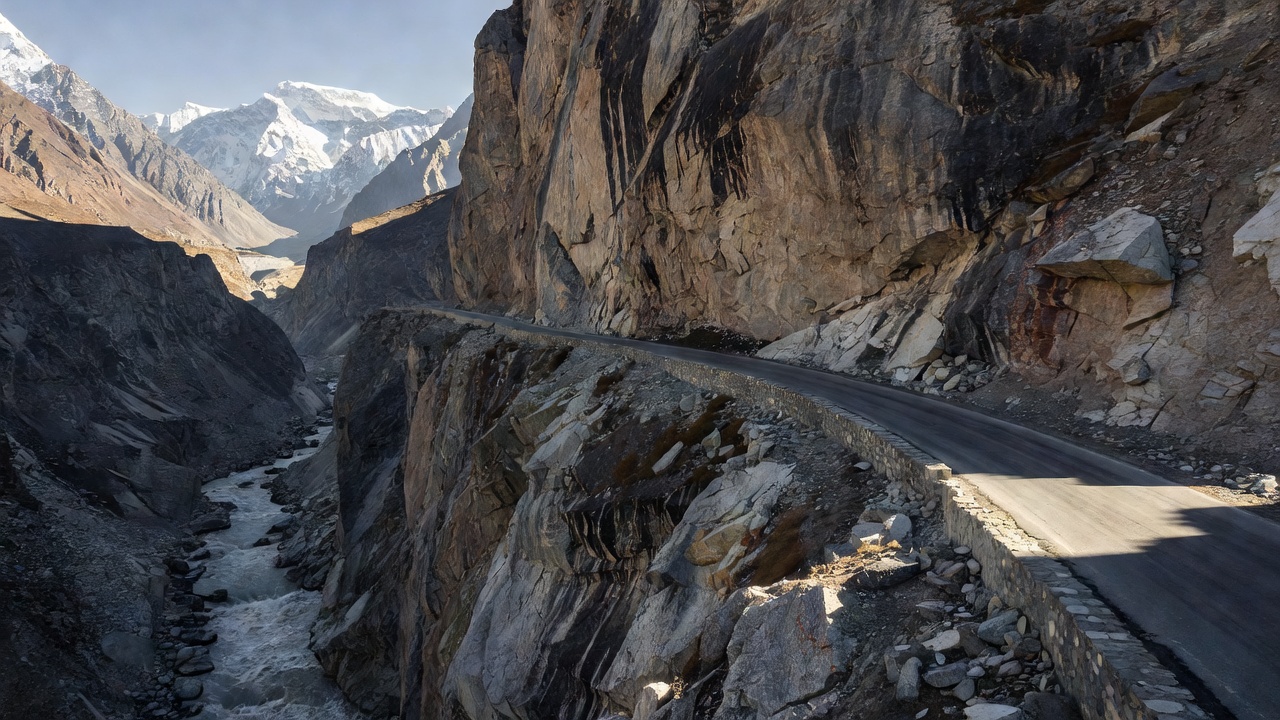
Spanning 1,300 kilometers from Hasan Abdal in Pakistan to Kashgar in Xinjiang, China, the Karakoram Highway (KKH) crosses the Khunjerab Pass at 4,693 meters. Often referred to as the "Eighth Wonder of the World," its construction claimed over 1,000 lives during two decades of dynamiting sheer granite along the Indus and Hunza river gorges.
The route remains in a perpetual battle with mass wasting. In 2010, an enormous landslide near Attabad village blocked the Hunza River, burying the highway and creating a 21-kilometer lake. Engineers responded by operating boat ferries for five years before constructing a series of five interconnected bypass tunnels directly through the granite mountain wall to restore all-weather land transit.