Alpine Switchbacks & Glacial Traverses
The European Alps represent the crucible of modern mountain highway engineering. Starting in the early 19th century under military directives from Napoleonic planners and Austrian imperial surveyors, engineers replaced pack-mule pathways with graded, paved corridors wide enough for carriage artillery and later internal combustion engines.
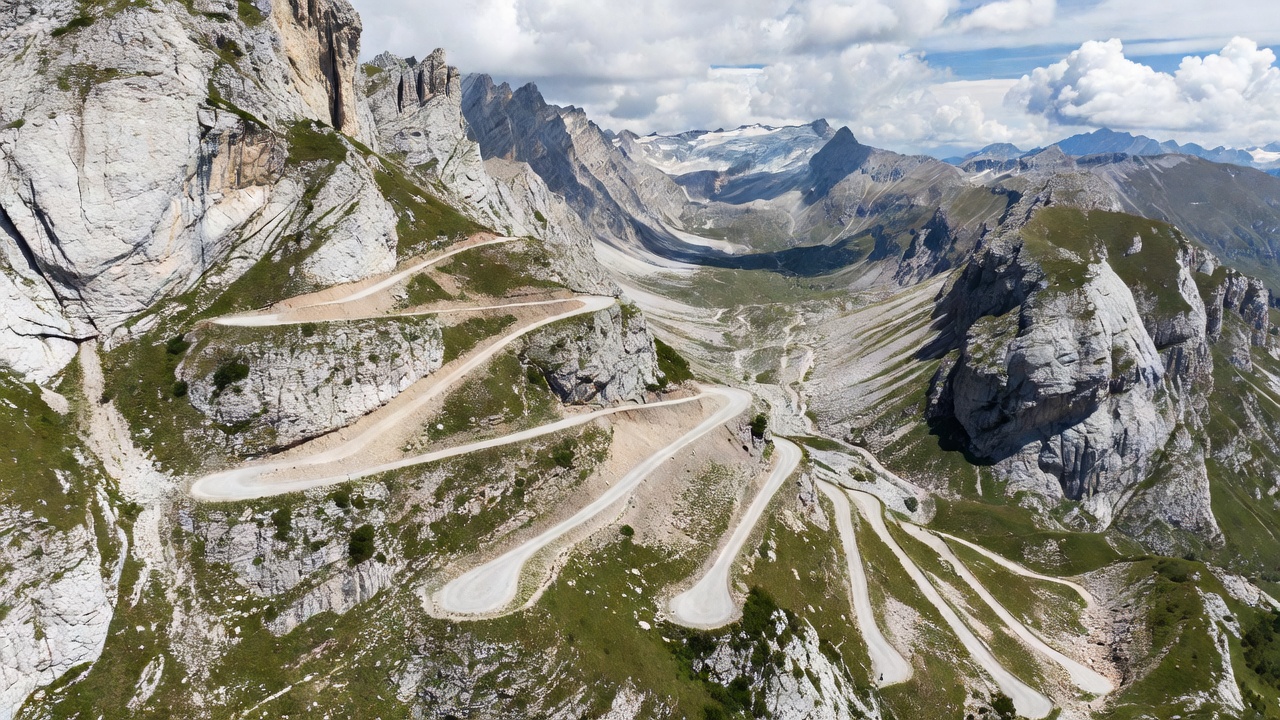
1. Passo dello Stelvio (2,757 m) – The Masterwork of Carlo Donegani
Constructed between 1820 and 1825 by the Austrian Empire to connect Lombardy directly with Vienna, Carlo Donegani's design remains largely unchanged along its iconic northern ramp from Prato allo Stelvio. The northern flank climbs 1,870 vertical meters across 48 numbered switchbacks, maintaining an average gradient of 7.4% and never exceeding 14%. Donegani achieved this uniform gradient by building massive dry-stone retaining buttresses that snake across unstable scree fans.
For modern drivers and cyclists, the northern wall presents a distinct cooling challenge. The tight turning radius of the lower 25 switchbacks requires second-gear deceleration followed by immediate hill-climbing acceleration. Ascending vehicles experience reduced ram-air airflow through radiators due to low road speed, causing coolant temperatures to creep toward 105°C even in 10°C ambient mountain air.
2. Col du Galibier & Col de la Bonette (France)
While Galibier (2,642 m) is steeped in Tour de France legend, it is also notable for the summit tunnel constructed in 1891 and the newer summit loop blasted in 1976. The final kilometer beneath the monument to Henri Desgrange peaks at 11% gradient through raw slate talus.
Further south, the Col de la Bonette (2,715 m) includes a circular scenic loop around the Cime de la Bonette, reaching 2,802 meters. This makes it the highest paved thoroughfare in the French Alps. The ascent cuts across a lunar landscape devoid of vegetation, where severe crosswinds through the notch can buffet high-sided campers without warning.
Thermal Dissipation on Alpine Descents
When descending 1,500 vertical meters from Stelvio to Bormio, potential energy is converted directly into heat via brake pads and rotors. A 1,800 kg passenger sedan converts approximately 26 megajoules of energy into heat over a 20-minute descent. Relying entirely on service brakes will boil standard DOT 4 brake fluid (boiling point ~230°C dry, ~155°C wet) in under 8 kilometers, leading to complete hydraulic pedal sink. Drivers must lock automatic transmissions into 2nd or 1st gear to exploit engine compression braking.
3. Grossglockner High Alpine Road (Austria)
Designed by engineer Franz Wallack during the Great Depression and opened in 1935, the Grossglockner Hochalpenstraße connects Salzburg and Carinthia over the Hochtor Pass (2,504 m). Unlike older military roads, Wallack engineered the route specifically for motorized tourism. He implemented extra-wide passing bays, gentle curve entries, and durable paving tailored to withstand 250 freeze-thaw cycles per calendar year.
Wallack also designed specialized rotary snow plows known as the "System Wallack" blowers, four of which remain in active service today. Each spring, two pairs of these diesel turbines clear upwards of 700,000 cubic meters of compressed packed snow to open the road by early May.